How a referral to Blood Cancer UK helped David process his diagnosis
A referral to Blood Cancer UK complemented David's NHS care by helping him and his wife process his diagnosis and access reliable information.
Case study
Patient: David, aged 77
Occupation: Retired social worker and former health service manager
Diagnosis: Marginal zone lymphoma
Treatment status: Active monitoring following radiotherapy
Referring site: Northumbria Healthcare NHS Foundation Trust
Diagnosis and referral
David was diagnosed in early 2025 after seeking medical advice about a persistent lump in his neck. Following investigations, biopsies and scans, he was diagnosed with marginal zone lymphoma. He underwent a short course of radiotherapy before moving onto active monitoring.
David described the NHS cancer pathway positively, highlighting how quickly he was seen at each stage and the strong support provided by his haematology team.
Northumbria’s haematology patient care coordinator conducted a holistic needs assessment (HNA) with David during a telephone appointment soon after his diagnosis. During the HNA, she asked David if he would like to be referred to Blood Cancer UK.
Initial hesitation about support
David was initially uncertain about accepting support from a charity.
"My original instinct was, 'Oh God, I can't be bothered with all this.'”
David felt sceptical about whether a charity could offer anything beyond the support he was already receiving from his healthcare team. He also describes himself as "not a great joiner" and someone unlikely to attend support groups.
Despite these reservations, he agreed to be referred as he was interested to receive information related to his diagnosis.
Reliable information at a vulnerable time
Following the referral, David received a series of seven weekly emails from Blood Cancer UK, covering topics including:
- coming to terms with diagnosis
- stories of other people affected by blood cancer
- sources of practical and financial support
- talking to family and friends.
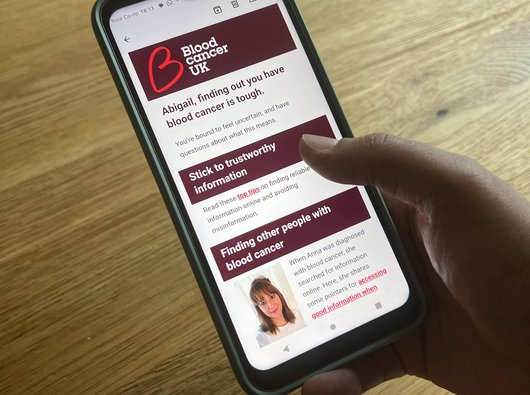
As well as reading the emails each week, David followed links in the emails to read further information on the Blood Cancer UK website. At a time when he was considering searching online independently, he valued having access to a trusted source of information.
The problem with looking online is all the nonsense you can get into if you're not careful. So it was a plus that what appeared to be a credible organisation based in this country was putting factual information up.
For healthcare professionals, this highlights the value of directing patients towards evidence-based information sources before they seek information elsewhere. A referral ensures patients get trusted, relevant and up-to-date information about blood cancer.
Blood Cancer UK’s health information is accredited by the PIF Tick, the UK’s only quality mark for health information.
Information delivered in manageable stages
One aspect David particularly appreciated was the structure of the support emails.
Rather than receiving everything at once, information was delivered in weekly, bite-sized emails, allowing him time to absorb and reflect on different aspects of living with blood cancer.
"Because it was spaced out… my tendency would have been to just read everything I could in about two days and consider it all done. But spacing it out, pointing out different avenues that one could go down and giving you a week to think about it, I thought it was worthwhile."
This approach helped keep information relevant and accessible during a period when he was processing his diagnosis.
Supporting family conversations
The referral benefited not only David but also his wife Diane, who was supporting him throughout his diagnosis and treatment journey.
David forwarded the emails to Diane each week and said the information prompted important conversations about the impact of blood cancer on them both.
"It was useful to be reminded… that I needed to think about how this was impacting her as well."
He described the emails as creating a regular point for discussion:
"It gave us a focus for a weekly discussion, if you like, to follow up."
This illustrates how referrals can support the wider family as well as the patient themselves.
Support for carers
Healthcare professionals can refer both patients and their carers to Blood Cancer UK. Carers receive an email journey tailored to their needs.

Bridging the gap between appointments
David has a highly supportive haematologist, who takes time to answer his questions and is always approachable. However, David recognises that frequent clinical appointments are not always possible. He valued the opportunity to explore information in between appointments.
It’s useful to explore information away from the clinical setting, in my own time. The info on the website allows me to think through what I need to know and to make best use of my clinical face to face time
Looking beyond information
David's engagement with Blood Cancer UK extended beyond the initial support emails. He continues to receive our regular email newsletter and appreciates feeling connected to the charity and keeping up-to-date with the latest developments in blood cancer treatment and research.
Through the newsletter, David learned about the Walk the World fundraising challenge. This challenged supporters to walk a combined total of 40,075km: the distance around the world and one kilometre for every person diagnosed with blood cancer in the UK each year.

David and his wife are keen walkers, but treatment and investigations had affected his motivation.
"The Walk the World thing came just at the point where I was thinking stuff all this walking, I can't be bothered. That came up and it gave me just a little extra edge to walk, a little bit more impetus to keep up with the walking at a time when I was probably at risk of thinking, 'I'll not bother.'"
This demonstrates how referrals can create ongoing opportunities for patients to stay connected, supported and motivated.
Key learning for healthcare professionals
David's experience highlights several benefits of referring patients to Blood Cancer UK:
- Patients may benefit even if they are initially reluctant to engage. David's first instinct was to decline support, yet he later described the referral as a positive experience.
- Trusted information can help patients navigate the overwhelming amount of information available online.
- Structured, staged information supports understanding and reflection over time.
- Support can extend beyond the patient to family members and carers.
- Information from Blood Cancer UK complements, rather than replaces, clinical care by filling gaps between appointments.
David's reflection
It was surprisingly effective in engaging me. It gave the two of us the opportunity to discuss what was going on in bite-sized chunks… I think it was a positive thing
When asked whether he would encourage other people diagnosed with blood cancer to accept a referral, David's response was clear:
"Yes, it was good for me, so I wouldn't hesitate to say do it."