
Supporting Clinical Nurse Specialists
Clinical Nurse Specialists (CNSs) in blood cancer care play a vital role in supporting people through diagnosis, treatment and complex decisions. New research shows many are highly committed to developing their skills but struggle to access the support they need with 91% saying workload is the biggest barrier to training.
This page shares what CNSs told us and the changes needed to strengthen this specialist workforce
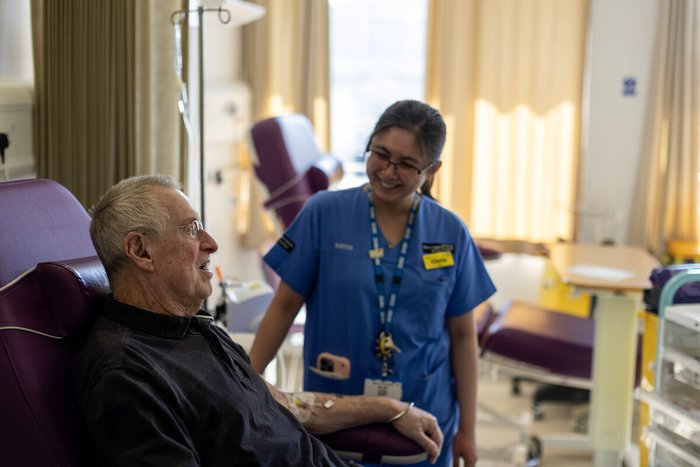
Research background
To understand what Blood Cancer CNSs need most, we combined published evidence with real‑world insights.
This included:
- A national survey of 176 Blood Cancer CNSs
- A review of UK and international research on specialist nursing
- Workshops with CNSs, people affected by blood cancer, educators and charity partners
This approach ensures our recommendations reflect both current evidence and the realities of frontline clinical practice.
Acknowledgement
This research would not have been possible without the expertise of Dr Julie Armoogum, Rachael Simms‑Moore, Professor Fiona Cramp and Dr Alison Llewellyn at the University of the West of England, and Dr Karen Campbell at Edinburgh Napier University.
This project has been funded by pharmaceutical companies. More information about the funders is available at the bottom of this page.
Taking part enabled our voice as a group of professionals to be heard and disseminated beyond my own local NHS Trust bubble.
- Jocelyn Habens, Myeloid Clinical Nurse Specialist
What the research shows
CNSs described consistent challenges in training, progression, emotional support and recognition. Below, each theme pairs what CNSs told us with the actions needed to address it.
Access to learning is also uneven across the UK. While some CNSs can attend training, others face barriers due to limited study leave, staffing pressures or lack of funding.
1. Education and training
Challenge
CNSs want accessible high quality education covering blood cancer, treatments and emerging therapies however, large gaps exists in training access:
- 52% received no training in education planning and delivery
- 45% received no training in clinical trials
- 44% received no training in survivorship and late effects
Many CNSs also highlighted the need for stronger communication skills, research training and leadership development to support their highly specialist roles.
Solution
Expand access to specialist education
Increase funding for accredited courses, haematology and oncology modules, and conferences. Strengthen partnerships with universities, charities and NHS education providers to widen learning opportunities.

2. Development pathways
Challenge
CNSs described inconsistent induction processes, unclear competency expectations and uneven access to Advanced Practice pathways, with many relying on local goodwill rather than structured development. Only 55% found accredited CPD straightforward to access.
Solution
Introduce structured development pathways
Create clear induction processes, competency frameworks and progression routes from early career to advanced practice. These should cover disease specific knowledge, clinical skills, communication, leadership, research and teaching.

After working across different Trusts, I’ve seen how varied CNS development can be. I wanted to understand this nationally and contribute to clearer, more consistent standards.
- Salma Bilkis, Haematology Clinical Nurse Specialist
3. Protected time
Challenge
The majority of CNSs struggle to access essential training due to limited time and heavy workloads:
- 91% said clinical workload stops them attending training
- 81% said study leave is limited or hard to secure
- Many said training often happens in their own time due to service pressures
Solution
Embed protected learning time
Embed protected study leave and backfill into job planning. A culture that values continuous learning will help CNSs access the training they need without adding pressure to clinical teams or sacrificing personal time.

4. Peer support
Challenge
Blood cancer care is emotionally demanding. CNSs identified emotional and peer support as their top real‑world priority, yet:
- 43% reported receiving no wellbeing support
- Many described feeling isolated or lacking reflective practice opportunities
Solution
Strengthen emotional and peer support
Provide regular clinical supervision and reflective practice. Support regional and national CNS networks and mentoring schemes to help CNSs share experiences and reduce professional isolation.

5. Role recognition
Challenge
Variation in job titles, scope and expectations can leave the CNS role misunderstood or undervalued within teams. CNSs expressed the need for clearer, more consistent role definitions across services.
Solution
Standardise and recognise the CNS role
Standardise CNS titles, scope and expectations across organisations. Ensure CNSs are included in multidisciplinary decision‑making and recognised for their specialist expertise.

6. Partnership working
CNSs experience uneven access to education and support, with training opportunities varying widely between organisations. They told us that stronger collaboration between charities, universities and professional bodies is needed to improve consistency, share best practice and reduce reliance on fragmented local support.
Solution
Strengthen cross sector collaboration
Encourage collaboration between charities, professional bodies, NHS organisations and education providers. Shared resources and coordinated training will help improve equity and consistency across services.

It felt important to get the CNS voice across. Hearing others facing the same challenges and knowing something is being done. Gives me hope for the future of the role
- Dawn Cousins, Myeloid CNS

Our next steps
This report marks the beginning of our commitment, through the UK blood cancer action plan, to develop a programme of continuous support for clinical nurse specialists working in blood cancer. We will work closely with our policy team, partners and NHS stakeholders to take these recommendations forward and turn them into meaningful, practical improvements for this essential part of the blood cancer workforce.
How you can use this
- Inform service planning, appraisals and workforce strategies
- Identify local training and support gaps
- Support business cases and funding applications
- Strengthen supervision, peer support and development structures
- Promote consistent CNS role recognition across teams
Stay connected
If you're interested in this work and would like to hear more, we'd love to stay in touch. By registering your details, we can keep you updated on progress and future opportunities to get involved.
Fill in the form below to register your interest and be the first to know what comes next.
Funding disclosure
This project has been funded by Roche, Amgen, Kyowa Kirin, Novartis and Eli Lilly. The companies provided funding but no input into the content or direction of the project
You might also be interested in

Online course for haemato-oncology
Whether you're a nurse, allied healthcare professional or have just qualified as a doctor, our online blood cancer course has something for everyone.
Refer your patients to Blood Cancer UK
Together we can enhance the support patients receive at diagnosis.
UK Blood Cancer Action Plan
Our Action Plan reveals shocking data about blood cancer survival in the UK. We need healthcare professionals and those affected by blood cancer to turn our set of recommendations into a reality.
Healthcare Professionals
Get the guidance you need to support you patients and find opportunities to lend your expertise to us.