Cancer Plan could change survival odds for people with blood cancer, but action must now match ambition
United Kingdom
Today on World Cancer Day (Wednesday 4th February) the Government launched a new National Cancer Plan for England, which Blood Cancer UK has long called for, as blood cancer survival in the UK continues to lag behind comparable countries.
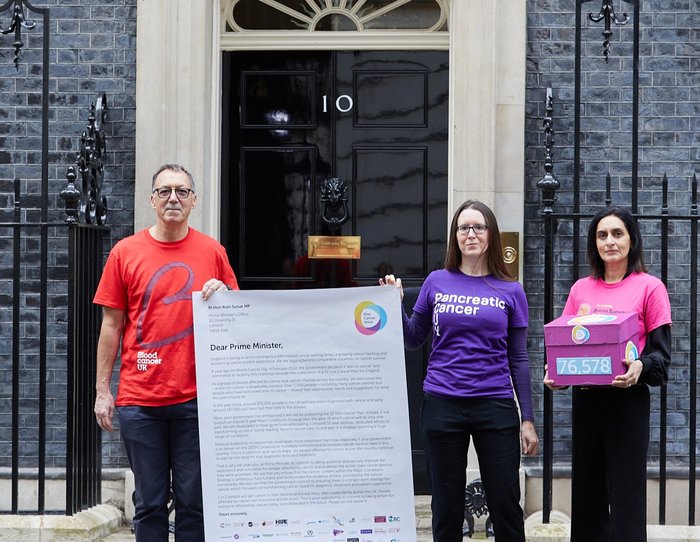
One Cancer Voice delivers our petition for a cancer plan to 10 Downing Street in 2023
The plan has the potential to improve survival for people with blood cancer, one of the UK’s biggest cancer killers, but its success will depend on whether commitments are properly funded, staffed and delivered in practice.
As part of One Cancer Voice, a coalition of cancer charities, we previously took the case for a national plan to Number 10 and gathered nearly 1,000 responses from people affected by blood cancer to inform our submission to Government.
What this National Cancer Plan means for people with blood cancer in England
There are several commitments in this plan that could make a real difference to people with blood cancer.
As the leading charitable funder of blood cancer research, it is particularly important that the plan highlights the need for the UK to be at the forefront of progress in cancer treatment. The plan includes steps to ensure more people are connected with charities for support when they are diagnosed with cancer.
Our charity stands ready to help implement this plan, including through our direct referral service, which enables hospital teams to connect blood cancer patients with specialist support at the point of diagnosis. This service is now live in 21 NHS trusts and has supported many hundreds of people already.
The plan also addresses a long-standing gap in how action on early diagnosis is measured. Government targets for diagnosing cancer earlier are based largely on staging, for example, increasing the proportion of cancers found at stage 1 or 2. But many blood cancers, like leukaemia, cannot be staged in the same way as solid tumours. We have argued for years that this means progress on diagnosing blood cancer earlier is harder to track, and risks being overlooked.
The Plan includes commitments to improve data for cancers that can’t be staged, including a recommendation from Blood Cancer UK to track emergency diagnoses as a proxy measure for earlier detection. Around a third of people with blood cancer are currently diagnosed in A&E, so reducing this would be a strong indicator that patients are being diagnosed sooner, before they become seriously unwell.
Where questions remain
We believe success will depend heavily on the NHS workforce, including haematology teams and clinical nurse specialists (CNSs).
New treatments and clinical trials are becoming more complex to deliver. And CNSs are often the main point of contact for people with blood cancer, coordinating care, managing side effects, and helping patients navigate a complicated health system. But our 2024 survey found that 31% of people who responded did not know who their clinical nurse specialist was, meaning they're missing out on vital support.
The National Cancer Plan focuses more on skills than significant workforce expansion, and the forthcoming NHS Workforce Plan will be critical to addressing whether there are enough specialist staff are in place.
This is a landmark moment for the 260,000 people living with or in remission from blood cancer in England and one we’ve been calling for over many years.
- Helen Rowntree, Blood Cancer UK's Chief Executive
Helen Rowntree, Chief Executive at Blood Cancer UK, said:
“This is a landmark moment for the 260,000 people living with or in remission from blood cancer in England and one we’ve been calling for over many years. Survival for blood cancer patients has fallen behind other nations of similar wealth and health, and people with blood cancer face some of the toughest odds. This plan could change that, but only if it’s delivered properly.
“There are important commitments here, from better support at diagnosis to improved data for cancers that can’t be staged, and continued investment in research. Blood cancer is at the cutting edge of many of the world’s most advanced treatments, including CAR T-cell therapy, and breakthroughs in blood cancer research have historically driven improvements across cancer care.
“But this plan will only succeed if the specific needs of people with blood cancer are built into how it’s put into practice. Many blood cancers are diagnosed in emergencies, can’t be staged in the usual way, and patients often need years of monitoring and specialist care. Improving survival means tackling these realities head on.
“Success will also depend on whether the plan is properly funded, progress is tracked, and the workforce is sufficiently staffed, trained, and supported. Without enough specialist staff, scientific breakthroughs simply won’t reach patients.
“Blood cancer remains the UK’s third biggest cancer killer and at Blood Cancer UK we’re determined to change this, standing ready to work with governments, the NHS and the wider cancer community so this plan leads to better, fairer outcomes for everyone affected by blood cancer.”
Help shape our policy work
If you’d like to help shape our policy work or hear more about what we do, join our Blood Cancer UK Policy Collective via our Involvement Network. It takes all of us working together to beat blood cancer.