“I was constantly consumed by it” – the hidden psychological burden of watch and wait cancer
United Kingdom
On World Blood Cancer Day, new estimates from Blood Cancer UK reveal more than 53,000 people in the UK currently living with blood cancer on active monitoring and not knowing whether their disease will progress.
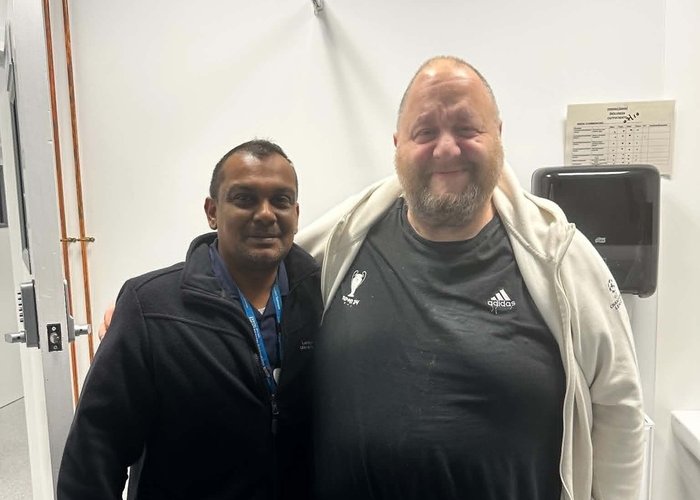
Joe (right) with Ravi, his Clinical Nurse Specialist
When Joe Beaver, 50, from Glasgow, was diagnosed with T-cell large granular lymphocyte leukaemia (TLGL) – a rare blood cancer – he thought the worst.
But unlike many cancer patients, Joe, who was living in London at the time, was not offered treatment. Instead, he was told to wait.
For the last four and a half years, Joe has been on ‘active monitoring’ – also known as ‘watch and wait’ – where patients are closely monitored until treatment is needed, if it is needed at all.
Joe says the uncertainty took a major toll on his mental health:
“You hear the word ‘cancer’ and immediately think the worst, people sometimes talk about ‘good cancers’, but there’s no such thing as a good cancer.
“I was continuously looking at medical letters. I was sitting at the computer 24/7 , Googling T-cell large granular lymphocyte leukaemia, Googling cancer, trying to work out what this meant. It actually caused problems in my relationship because I was constantly consumed by it.”
On World Blood Cancer Day, new estimates from Blood Cancer UK reveal Joe is one of more than 53,000 people in the UK currently living with blood cancer on active monitoring and not knowing whether their disease will progress.
Even now, four and a half years later, it’s always in the back of your mind. You just can’t tell one day from the next. Appointments come and go and life carries on, but it’s always there.
- Joe Beaver
Unlike many cancers, some blood cancers do not need immediate treatment, and research shows that for some conditions, treating people straight away would not improve outcomes.
The new data shows that 53,000 people – around 16% of all those living with blood cancer - are currently on active monitoring, including over 40,000 with chronic lymphocytic leukaemia (CLL), 6,500 with follicular lymphoma (FL) and 6,000 with myeloma.
But while treatment may be delayed, or never needed at all, Blood Cancer UK says for many, it can feel like living in limbo, especially as early treatment is promoted in general cancer advice, and treatment delay is typically discouraged and associated with worse outcomes.
Joe said:
“When I was told I had cancer but didn’t need treatment, I didn’t know how to feel. You feel fine, but you’re told something serious is there. At first, I did the bad thing and went to Dr Google. It just sends your mind racing. You’re reading all sorts and thinking: ‘How long have I got left?’.
“Even now, four and a half years later, it’s always in the back of your mind. You just can’t tell one day from the next. Appointments come and go and life carries on, but it’s always there. Your bloods can be fine, then suddenly something changes. People do always say, ‘Oh, it’s the good type of leukaemia’, but how can anything be a good cancer? It can’t.”
The figures have been calculated by the Haematological Malignancy Research Network (HMRN) a specialist population-based registry established over 20 years ago. One of the benefits of HMRN is that it shows how patients are managed over time, from diagnosis onwards, meaning that researchers know how long patients are monitored for and how many go on to receive treatment.
Lead researcher at HMRN, Professor Alex Smith, said:
“One of the strengths of HMRN is that we can use our data to give patients an idea about what they could expect in the future, as a consequence of their diagnosis. Importantly, we can confirm that for some conditions many patients on active monitoring will never require treatment and that their diagnosis will not impact their life-expectancy. Information like this can address uncertainties and provide reassurance for patients and families.”
Joe says support from a clinical nurse specialist made a major difference.
“What really helped was being able to talk to the clinical nurse specialist,” he said.
“I could phone him anytime. Even when I was worrying, he would talk things through, explain my bloods and reassure me. Being able to ask questions and get reassurance made a big difference.”
Fiona Gebbie, support nurse at Blood Cancer UK, said:
“Being on active monitoring can be very hard, people are told they have cancer, but they are not treated. That can feel confusing and frightening; this growing number shows that even more people than previously thought need the right support to cope with the emotional impact. No one with blood cancer should feel alone, whether they are on treatment or not.
“Our support is there for anyone who has just been diagnosed and is trying to make sense of what active monitoring means. It gives you clear, simple information, practical tips and advice from others who’ve been through it, to help you through those first few weeks and months.”
Blood cancer is the third biggest cancer killer in the UK yet remains widely misunderstood. On World Blood Cancer Day, Blood Cancer UK is encouraging people like Joe, and the thousands with blood cancer to share their experiences to raise awareness of the condition.