
What does the National Cancer Plan for England mean for people living with blood cancer?
On 4th February 2026, the Government published its National Cancer Plan for England. Central to this Plan is the ambition to drive up survival rates across all cancers, including less common ones, by 2035. We’ve long called for a national plan that could improve survival and quality of life, making this a significant moment for people living in England with blood cancer.
Our UK Blood Cancer Action Plan told the government what it takes to beat blood cancer. We’re encouraged to see action on some of our recommendations reflected in this National Cancer Plan. Below, we set out what the Plan could mean in practice for the blood cancer community and where we’ll be pushing next to make sure ambition turns into impact. Our initial response to the Plan can be found here.
50% of people are likely to be diagnosed with a cancer, meaning 100% of us will be impacted- that's why this Plan is so important
- Mel Plumridge, Blood Cancer UK Ambassador
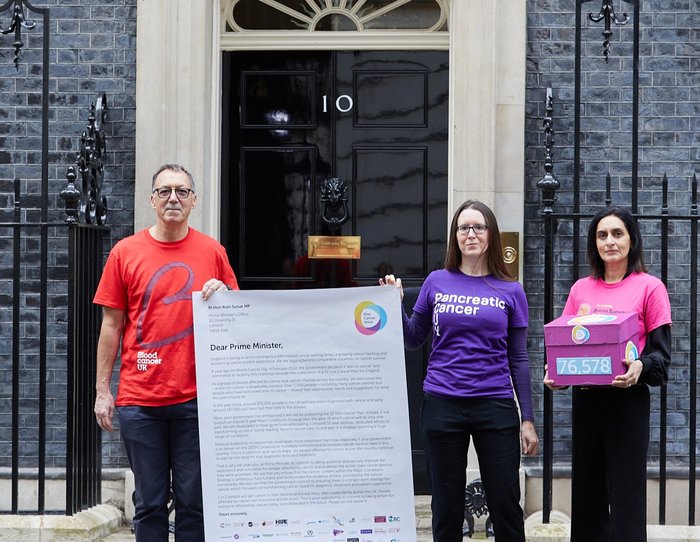
Mel outside 10 Downing Street delivering a petition calling for a national cancer plan.
From overlooked to included
Unlike previous cancer strategies, this Plan mostly refers to ‘blood cancer’, rather than using technical labels or listing subtypes. That matters.
84% of our community agree blood cancer doesn’t get enough political attention. Clear, inclusive language helps ensure blood cancer is visible in policy decisions and that people affected get the recognition, support and care they deserve. We’ve long called for this shift, and it’s encouraging to see it reflected here.
Blood Cancer UK funded trial celebrated in the Plan
We're pleased that the Plan identifies the RAPID and RATHL trials we part funded, as an example of new approaches to finding new, gentler treatments. The trials helped Hodgkin lymphoma patients receive less intensive treatment through the use of PET imaging. Read more here.
Acknowledging the realities of blood cancer
The Plan recognises an important reality; blood cancer doesn’t behave like many other cancers. Some blood cancers can’t be staged in the same way as solid tumours. This means blood cancer has been left out of how early diagnosis progress is measured, making it harder to track improvement or target action.
The Plan commits to changing this by publishing regular data on emergency diagnoses for cancers that can’t be staged. Being diagnosed in A&E is often a sign that cancer wasn’t picked up early enough. Tracking these diagnoses will give the NHS a clearer picture of whether people with blood cancer are being diagnosed sooner and create stronger incentives to improve early diagnosis. This is a recommendation we called for in our Action Plan so we’re pleased it has been actioned.
Support at the point of diagnosis
No one should face a life-changing cancer diagnosis alone. That’s why we welcome the Plan’s commitment to expand the Diagnosis Connect programme.
Diagnosis Connect automatically refers people to specialist charities at diagnosis, rather than leaving them to seek support themselves. The programme currently operates in primary care, and the Plan commits to expand it into secondary care, where most people receive a cancer diagnosis.
We already have our direct referral service up and running in 21 hospital trusts. We’re actively sharing our experience with the Government to help ensure Diagnosis Connect is successful as it expands.
Living with blood cancer
The Plan includes practical commitments that could improve day-to-day life for people living with blood cancer. From this year, everyone diagnosed with cancer will receive a needs assessment at diagnosis, informing a personalised care plan covering treatment, physical and mental health, and wider needs like work and finances. By 2028, these plans will be accessible through the NHS App.
Clinical nurse specialists (CNSs) are a cornerstone of blood cancer care. Yet our 2024 survey found that 31% of people with blood cancer didn’t know who their CNS was, missing out on vital support. That’s why we welcome the commitment to ensure every cancer patient has a CNS or other named professional as their main point of contact, with easier access via the NHS App.
The Plan also recognises the financial and employment impact of cancer, with commitments to help people stay in or return to work if they want to.
A win for blood cancer
For children and young people with cancer, up to £10 million a year will be available to help cover travel costs.
Getting the right treatments, in the right places
The Plan recognises the transformational impact of treatments like CAR T-cell therapy and commits to incentivising more care in specialist centres, where outcomes are often better. At the same time, it looks ahead to a future where more treatments can safely be delivered at home or in community settings.
It also recognises that access to new treatments is not equal. Too often, where someone lives can determine how quickly they benefit from innovation. This year, we’re running a new policy project to identify where this variation exists in blood cancer and propose practical solutions for governments, the NHS and wider services.
Research and innovation- the key to survival
Research is the driver of progress in blood cancer survival. We’ve invested more than £500 million in research, so we welcome the Plan’s commitment to putting the UK at the forefront of cancer innovation and to working in partnership with charities.
The Plan positions research, development and innovation as central to improving survival, including a strong focus on expanding access to clinical trials. It commits to tackling long-standing barriers to participation, including for people with rare cancers, those from poorer areas and people from ethnic minority communities.
Trials will be offered across a wider range of settings and integrated into the NHS App. We’re keen to see this translate into real change, building on work we already do through our Clinical Trial Support Service.
Building on the Rare Cancers Bill, the Plan makes research into rare cancers a priority, including appointing a named lead to drive progress.
Survival for blood cancer patients has fallen behind other nations of similar wealth and health, and people with blood cancer face some of the toughest odds. This plan could change that, but only if it’s delivered properly
- Helen Rowntree, Chief Executive of Blood Cancer UK
Turning ambition into impact
The National Cancer Plan sets a promising direction. Our focus is now making sure its ambition becomes real change for people affected by blood cancer.
We’ve already started. We have briefed MPs on what delivery must look like; from bold, long-term NHS workforce planning, more detail on how commitments in the Plan will be funded, how the Government will measure progress on its commitments, and what levers the wider health system will be given to drive change.
We were pleased to see these points raised directly with the Minister in the House of Commons, you can watch the clip here.
We’ll continue to engage closely with the development of the forthcoming NHS 10 Year Workforce Plan to ensure it reflects the needs of the blood cancer community. We welcome the Plan’s commitment to better distributing the workforce across the country, particularly in rural and deprived areas where staff shortages are worse, but we need to see more workforce investment to deliver this and to make sure people with blood cancer benefit.
Blood Cancer UK will continue to work with the Government, the NHS and partners so this Plan leads to real, lasting improvements for everyone affected by blood cancer.
Beyond England: the UK picture
We’ve been calling for a long-term cancer strategy in England because evidence shows that countries with a strategic and committed approach to planning and delivering cancer services see better survival rates.
Health is devolved, meaning the governments of Scotland, Wales and Northern Ireland are responsible for how the NHS in those nations are funded and delivered.
Scotland and Northern Ireland already have long-term cancer strategies and we’re working to ensure their commitments are properly funded and delivered. Wales is now the only UK nation without a government-led, long-term vision for cancer. We’re campaigning to change that, starting with our manifesto for the 2026 Welsh Parliament (Senedd Cymru) elections.
2026 Devolved Nations Elections
On 7th May, Wales and Scotland will elect new members of the Welsh and Scottish parliaments. We know what it takes to beat blood cancer in Scotland and Wales. Download and read our manifestos:
Now we need your help
To make sure this Plan truly delivers better, fairer outcomes for everyone affected by blood cancer we need you. Join our Policy Collective by signing up to our Involvement Network and register your interest in our policy and influencing work.