
Understanding how plasma cells become cancerous in myeloma
Myeloma is a type of blood cancer that affects a type of white blood cell called plasma cells. Professor Reuben Tooze hopes to understand more about how plasma cells become cancerous and can divide and multiply out of control, so that new ways to diagnose and treat this disease can be developed.
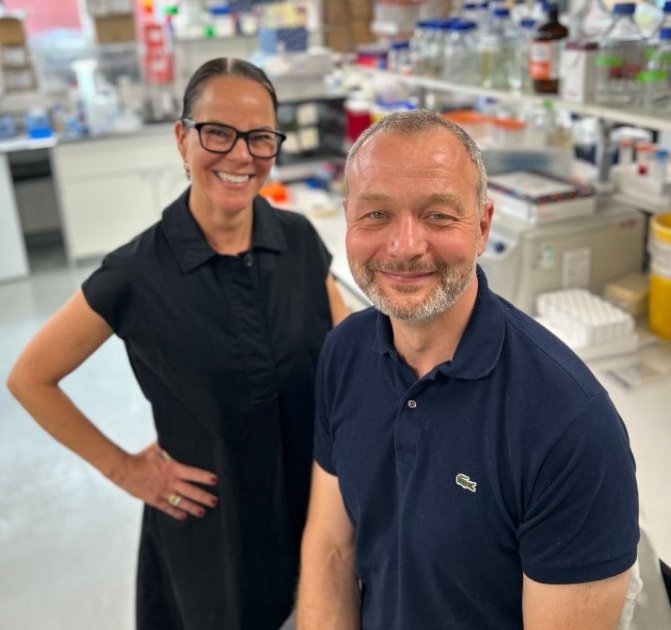
Professor Tooze and his colleague in the lab
Project information
- Lead researcher
Professor Reuben Tooze, University of Leeds
- Research team
-
- A team at University of Leeds
- Related conditions
-
- Myeloma
- Research type
-
- Non-clinical
- Region
-
- North West
- Grant awarded
-
- Project Grant
- Status
- Ongoing
- Funding award date
- December 2023
- Amount awarded
£275,717.9
The challenge
Plasma cells are a type of white blood cell made inside our bone marrow (the spongy material inside some of our bones). They’re an important part of our body’s immune system as they produce antibodies that find and kill bacteria and viruses that cause infections.
Because of this special role that plasma cells have, it means they cannot divide and make copies of themselves quickly. However, sometimes these plasma cells transform into cancerous cells called myeloma and gain the ability to divide and multiply rapidly and become out of control.
The project
Professor Tooze and his team want to understand more about how, unlike healthy plasma cells, the cancerous myeloma cells are able to divide and multiply out of control. He plans to study a specific gene called ‘MAF’, which is often linked to the disease.
Research has found the MAF gene is present in 10% of people in the early stages of myeloma. Professor Tooze has developed a test to try to understand what the MAF gene does to plasma cells to make the myeloma cancer cells multiply and grow in numbers.
He believes conducting this test is key to understanding how plasma cells become cancerous so that new ways to diagnose and treat this disease can be developed.
The future
If successful, Professor Tooze could use this new understanding of how plasma cells become cancerous to find ways to treat early disease before it becomes aggressive. They hope this research will enable quicker diagnosis and treatment of myeloma, improving quality of life and giving people the best possible chance of survival.
Find out more
Our research
Thanks to our blood cancer community, we've invested over £500 million into research since 1960. Our discoveries have led to better and kinder treatments, and transformed lives.

Support for you
We’re here for anyone worried about or affected by blood cancer. Call our free blood cancer support line, email us or join our online community.

Blood cancer types
Understand all the different types of blood cancer and find information and support.

Clinical Trials Support Service
Find out how our Clinical Trials Support Service can help you.