
Understanding how we could make better drug treatments to target acute myeloid leukaemia (AML)
Acute myeloid leukaemia (AML) develops quickly and often needs urgent treatment. Dr Payne wants to understand more about a specific alteration that causes AML, to help develop new, more effective drug treatments with fewer side effects that only target the cancer cells.
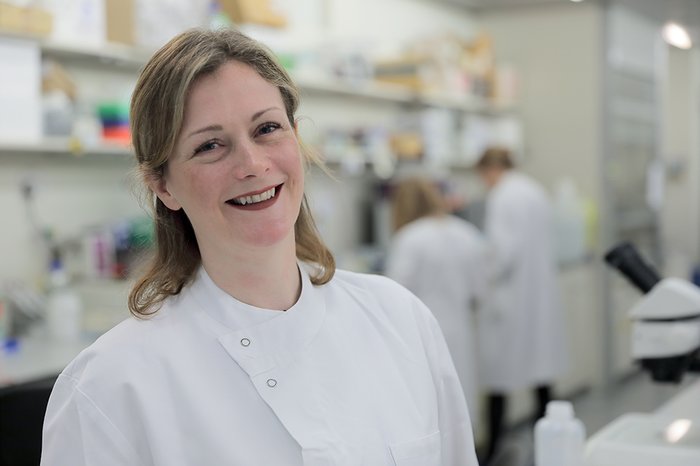
Dr Payne in the lab
Project information
- Lead researcher
Dr Elspeth Payne, University College London
- Research team
-
- A team at University College London
- Related conditions
-
- Acute myeloid leukaemia (AML)
- Research type
-
- Non-clinical
- Region
-
- London
- Grant awarded
-
- Project Grant
- Status
- Ongoing
- Funding award date
- November 2023
- Amount awarded
£278,842.22
The challenge
Acute myeloid leukaemia (AML) is a type of blood cancer that develops quickly and often needs urgent treatment. It causes blood cells undergo unusual alterations in their genetic code that means they don’t behave as they should.
Many treatments for AML work by killing any cell that divides quickly. This also includes healthy cells, which causes lots of harsh side effects.
To combat this, researchers are trying to develop new treatments that target only the cancer cells, leaving healthy cells unharmed, meaning fewer side effects from treatment.
The project
Dr Payne and her team are studying a type of AML that is caused by alterations in a specific gene called ‘CEBPA’.
This specific alteration is present 10-20% of people with AML. Many alterations that cause AML can be targeted using drug treatments. However, this is not the case with the CEBPA alteration which cannot be targeted with drug treatments.
Dr Payne wants to understand how AML cells that have the CEBPA alteration are different to normal cells and why drugs are unable to target this.
By understanding more about this alteration, she hopes to work out how they could make a drug that can target this kind of leukaemia.
The future
Dr Payne’s research will help us to understand more about the AML cells that have the CEBPA alteration. This could result in the development of more effective drug treatments for AML in the future with less side effects that specifically target this alteration, allowing more people to respond well to treatment.
Find out more
Our research
Thanks to our blood cancer community, we've invested over £500 million into research since 1960. Our discoveries have led to better and kinder treatments, and transformed lives.

Support for you
Get free support from our specialist nurses, join our online community and access information you can trust.

Blood cancer types
Understand all the different types of blood cancer and find information and support.

Clinical trials
Clinical trials are how new treatments are developed and improved. Find information and support at every stage of your journey.