
Treatment for T-cell acute lymphoblastic leukaemia (T-ALL)
For most people, the aim of their treatment for T-cell acute lymphoblastic leukaemia will be to completely get rid of the leukaemia cells inside their body and cure the T-ALL. This usually means having an intensive treatment plan lasting around two to three years.
Key things to know
- It’s very important to start treatment soon after you’ve been diagnosed, because T-ALL can develop quickly.
- T-ALL treatment is generally divided into three phases: remission induction, consolidation and maintenance.
- Your doctor will carefully consider the risk of your T-ALL coming back when planning each phase of your treatment.
- Some people have a stem cell transplant as part of their treatment.
- There will be times where you will be more at risk of infection.
Planning your treatment
Research has shown that planning treatment based on how likely a person’s T-ALL is to come back (relapse), can make a big difference to their chances of being cured. This means that your doctor will carefully consider the risk of your T-ALL relapsing when they’re planning each phase of your treatment.
We have more information about blood cancer treatment planning.
You will be treated in a specialist haematology or cancer centre by a hospital team that is experienced in treating leukaemia. This is so that you receive the most appropriate treatment and expertise. This might mean that you will be treated in a different hospital to where you were diagnosed.
If you're a young adult
If you are a young adult aged 24 or under, you should be given the option to be treated in a teenage and young adult (TYA) unit. These are specialist centres which provide additional support for young adults, including services that help with their mental, emotional and social wellbeing. You don’t have to be treated in a TYA unit. If you choose not to be treated in your nearest TYA unit, you will be treated in a specialist haematology hospital which is approved to care for young adults.
We have more information about different treatment centres for young adults. It includes some questions you might want to think about if you have a choice about where you’re treated.
ALLTogether-1 clinical trial
If you have recently been diagnosed with T-ALL and are under 29 years old, you may be invited to take part in a large clinical trial called ALLTogether-1. The ALLTogether-1 trial is investigating whether treatment for ALL can be made gentler but just as effective for people with a lower chance of the leukaemia coming back.
This trial is looking at how standard treatment can be adjusted to improve outcomes for people with ALL.
If you have a higher risk of the T-ALL coming back (relapsing), you may be given a drug called nelarabine at some stage during the early phases of your treatment. This is added to standard chemotherapy to help lower the risk of the leukaemia coming back.
The trial is running until May 2027. Find out more about the ALLTogether-1 trial.

Information for young adults
For young adults with leukaemia and other types of blood cancer: your guide to treatment, side effects, coping with emotions, friends and work or study.
Treatment for T-cell acute lymphoblastic leukaemia
T-ALL treatment is generally divided into three phases
- remission induction
- consolidation
- maintenance
Remission induction
The first phase of treatment for T-ALL is called “remission induction”. Remission induction for T-ALL usually consists of steroids and intensive chemotherapy. These drugs will work in different ways to destroy the leukaemia cells inside your blood and bone marrow.
This phase of treatment usually lasts between four weeks and two months, but your hospital team will be able to give you a better idea of how long it might take for you individually. You’re likely to spend all, or most, of this stage in hospital. Your hospital team will keep a close eye on you and how your body is responding to your treatment.
The exact drugs you will receive will depend on the treatment protocol you’re on. Your hospital team will give you more information about this. They’ll also give you information about what side effects to look out for.
Below are some of the drugs used in remission induction treatment for T-ALL.
Steroids
Steroids help to destroy the leukaemia cells in your blood and bone marrow. They’re a really important part of treatment.
- dexamethasone
- prednisone.
Chemotherapy
Chemotherapy means using cell-killing drugs to destroy cancer cells.
The chemotherapy drugs and the doses you’re given during remission induction will depend on your treatment protocol. You may be given a combination of the below chemotherapy drugs:
- cyclophosphamide
- vincristine
- doxorubicin
- asparaginase
- daunorubicin
- cyclophosphamide
- cytarabine
- methotrexate
Intrathecal chemotherapy
During the phases of your treatment for T-ALL, you will likely receive injections of chemotherapy drugs directly into the fluid around your brain and spinal cord. This is called the cerebrospinal fluid (CSF). The aim of this is to destroy any leukaemia cells that have got into the fluid, and to prevent any leukaemia cells from entering it in the future. This type of treatment is called intrathecal chemotherapy. It’s not usually painful and takes about 20 minutes.
Remember
You will be at a much higher risk of getting infections while you are having treatment. It’s really important that you know how to spot an infection, and what to do if you’re worried you have an infection.
Testing for remission
After your remission induction treatment, doctors will look at samples of your blood and bone marrow under a microscope. They will look to see whether any leukaemia cells can still be detected.
Minimal residual disease test (MRD)
A minimal residual disease test (MRD), is a very sensitive test which measures the number of leukaemia cells in a sample of your bone marrow. It can find tiny amounts of leukaemia cells that cannot be seen through a normal microscope. These leftover leukaemia cells are called minimal residual disease. You might also hear it called “measurable residual disease”.
- If you are MRD-positive, it means that there are still some leukaemia cells left in your blood or bone marrow.
- If you are MRD-negative, it means that no leukaemia cells have been detected in your blood or bone marrow.
An MRD-positive result suggests that there’s a higher chance that the T-ALL will relapse. An MRD-negative result suggests that there’s a lower chance that the T-ALL will come back (relapse).
Measuring the amount of leukaemia cells left in your blood after your remission induction treatment, gives your doctor a better understanding of how deep your remission is. They’ll use this information to create an individual treatment plan for you for the next phase of your T-ALL treatment.
Consolidation
The consolidation phase of treatment aims to kill any leukaemia cells that may still be in your blood or bone marrow, even if you are MRD-negative (no leukaemia cells have been detected).
You will therefore have more treatment to get rid of the leukaemia cells left in your blood and bone marrow and reduce the risk of the T-ALL coming back (relapsing).
This phase of treatment usually takes about three to four months, but it will depend on your individual treatment plan. You will usually have this stage of treatment in "ambulatory care". This means you will go to hospital regularly for your treatment, blood tests and check ups, but you will often be able go home afterwards, rather than staying overnight.
Consolidation treatment for T-ALL usually involves a combination of steroids, chemotherapy and for some people, a donor stem cell transplant.
The exact drugs and doses of drugs you will receive will depend on the treatment protocol you’re on.
Chemotherapy drugs
Below are some of the drugs used in consolidation treatment for T-ALL, but you may have other chemotherapy drugs if you are going to have a donor stem cell transplant.
- vincristine
- doxorubicin
- asparaginase
- cytarabine
- mercaptopurine
- methotrexate
Stem cell transplant
If the T-ALL is at a high risk of coming back (relapsing), you might be told by your hospital team that you need a donor stem cell transplant as part of your consolidation treatment.
A stem cell transplant aims to completely wipe out your immune system and your bone marrow, and replace it with new, healthy stem cells from another person (a donor). It’s a very intensive type of treatment which comes with the risk of serious side effects. Your hospital team will only recommend a stem cell transplant if they believe that the chances of you being cured are higher than the risk of you having serious complications.
We have a booklet on stem cell transplants that you can order for free on our online shop. See: Allogeneic (donor) stem cell transplants: the seven steps.
Maintenance
The third phase of treatment for T-ALL is called “maintenance”. It’s likely that you won’t have this phase of treatment if you received a stem cell transplant during your consolidation phase. Speak to your hospital team if you’re unsure.
The goal of the maintenance phase treatment is to prevent the T-ALL from coming back (relapsing) while allowing you to return to your normal daily life, like going back to college, work and playing sports.
During your maintenance treatment, you will still receive chemotherapy, but it’ll be less intensive than your earlier phases of treatment. Maintenance treatment can be taken in tablet form, or given to you as an outpatient in hospital, so unless you get an infection or experience complications, you won’t need to stay in hospital.
The maintenance phase of treatment usually lasts about two years, but the exact length can depend on you individually and your treatment plan. Your hospital team will be able to give you more information about what the maintenance phase of treatment will look like for you and how they will monitor you.
The maintenance phase is really important because without it, there’s a higher chance that the T-ALL could come back, even if your tests show that you’re in full remission.
It's therefore really important that you follow your maintenance treatment plan every day, exactly how your hospital team advises. You’ll likely need to take different drugs on different days, so you might want to find something that works for you, that helps you to do this. You might find keeping a paper or digital chart handy, setting alarms for when you need to take different drugs, or organising pill boxes into clearly labelled compartments.
Drugs you might receive during the maintenance phase include:
Steroids:
- dexamethasone
- prednisolone
Chemotherapy:
- 6-mercaptopurine
- Vincristine
Intrathecal chemotherapy
You will also likely have more intrathecal chemotherapy during the maintenance phase of your treatment. This involves having a drug called methotrexate directly into the fluid around your brain and spinal cord (cerebrospinal fluid or CSF), through an injection in your lower back. The aim of this is to prevent any leukaemia cells from entering your CSF in the future.
If your treatment stops working or the T-ALL comes back
If the T-ALL is refractory, it means that your treatment isn’t working as it should, or it’s stopped working to destroy the leukaemia cells in your blood and bone marrow.
If the T-ALL has relapsed, it means that your T-ALL has come back after you’ve been in remission.
Hearing that your treatment isn’t working or that your T-ALL has come back can be very upsetting.
Your doctor will talk to you about what’s right for you and listen to your wishes around treatment. Don’t be afraid to bring up any questions or concerns you may have.
Treatments for relapsed and refractory T-ALL
Your doctor will agree on a treatment plan for you with a team of medical experts in a multidisciplinary meeting. If the T-ALL relapses or does not respond to treatment, you will likely be given further treatment to try to get you back into remission. This will probably involve more steroids and intensive chemotherapy.
Once you have had treatment to get you back into remission, it’s likely that you will also need to have an allogeneic (donor) stem cell transplant, to give you the best chance of staying in remission and being cured.
We talk about some of the different treatment options for relapsed and refractory T-ALL below. The exact drugs and doses of drugs you will receive, will depend on the treatment plan (protocol) you are on.
Chemotherapy
Nelarabine
If your T-ALL has come back after you’ve been in a period of remission, or the T-ALL isn’t responding to your treatment, you might be given a chemotherapy drug called Nelarabine. It works by entering the leukaemia cells and stopping them from growing and dividing. This causes them to die off.
You might have nelarabine on its own, or you might have it along with other chemotherapy drugs. Some people are given nelarabine to help put the T-ALL into remission before they have a donor (allogeneic) stem cell transplant.
Nelarabine is given intravenously, which means it will be given straight into your bloodstream through a vein.
Nelarabine can cause problems with the way your brain and nerves work. You’ll therefore be closely observed by your treatment team when you’re given this drug. We have more information here (anchor link to side effects of T-ALL treatment a few pages down).
FLAG or FLAG-ida
You may receive a combination of chemotherapy drugs called FLAG or FLAG-ida.
- fludarabine – a type of chemotherapy drug
- cytarabine – a type of chemotherapy drug
- G-CSF – you might be given a drug called a growth factor, which helps your bone marrow to make more neutrophils (a type of white blood cell that helps fight infection).
You might also receive idarubicin, another type of chemotherapy drug, as part of a more intensive treatment protocol called FLAG-Ida.
Your doctor will agree on a treatment plan for you with a team of medical experts in a multidisciplinary meeting.
Allogeneic (donor) stem cell transplant
After you’ve had more treatment to get you into remission, you will likely need an allogeneic (donor) stem cell transplant to give you the best chance of staying in remission and being cured. A stem cell transplant aims to completely wipe out your immune system and your bone marrow, and replace it with new, healthy stem cells from another person (a donor).
You will first have treatment to get your body ready for the stem cell transplant. This is called “conditioning therapy.” Conditioning therapy involves having chemotherapy to make space in the bone marrow for the healthy stem cells from your donor and suppresses your immune system to stop your body from fighting the new donor cells. Depending on how intensive your treatment plan (protocol) is, the conditioning therapy might also aim to kill any remaining leukaemia cells in your bone marrow. Some people have other types of treatment as part of their conditioning therapy as well, such as radiotherapy.
An allogeneic (donor) stem cell transplant is a highly intensive type of treatment which comes with the risk of serious side effects. Your hospital team will only recommend a stem cell transplant if they believe that the chances of you being cured are higher than the risk of you having serious complications.
If your body is unlikely to be able to cope with the intensity of a standard stem cell transplant, you might still be able to have a stem cell transplant if you have a closely matched donor. In these cases, your conditioning therapy will use lower doses of chemotherapy to prepare your body for the stem cell transplant. This is called “reduced intensity conditioning” (RIC).
We have a booklet on stem cell transplants called Allogeneic (donor) stem cell transplants: the seven steps. You can order it free, here.
Clinical trials for T-ALL
Researchers are working hard to research how immunotherapy and targeted treatments could be used to improve outcomes for people with T-ALL. There may be opportunities to take part in a clinical trial as part of your treatment for T-ALL. Clinical trials aim to find new treatments and improve existing ones. Taking part in a clinical trial might give you access to new treatments not available outside the study, but it’s always your choice.
Your doctor may talk to you about clinical trials, but don’t be afraid to ask if there might be clinical trials you may be eligible for.
If you'd like to know more about clinical trials, you can contact our clinical trials navigation service.

Speak to our clinical trials navigation service
Our free clinical trials navigation service can help you decide if a trial is right for you. See our online information. Or speak to one of our specialist nurses for personal support.
Less intensive treatment
There may be reasons why curing your T-ALL is no longer possible. This might be because your T-ALL keeps coming back after treatment, or you’re not able to have the intensity of treatment needed to cure your T-ALL.
If you’ve been told that a cure is no longer possible, you may be given a less intensive treatment plan. This likely won’t be strong enough to kill all of the leukaemia cells in your blood and bone marrow. The aim of this treatment will instead focus on controlling the T-ALL - stopping the disease spreading as quickly and making sure you’re as comfortable as possible.
Less intensive treatment for T-ALL often includes oral chemotherapy and steroids, so you’ll likely be able to have a lot of this treatment at home. You’ll still have lots of care and support from your hospital team. They will refer you to the palliative care team, who will be able to offer both emotional and practical support to both you and your family.
Hearing that your leukaemia can’t be cured can be overwhelming and deeply upsetting. It can take time for you and your loved ones to process this news. Remember that you do not have to face this alone. If you need someone to talk to or want support you ask a blood cancer nurse. Call 0808 2080 888 or email [email protected].
Treatment side effects
Treatment for T-ALL can cause a range of different side effects, but you are unlikely to have all of them. Everyone is different.
Tell your hospital team as soon as you notice a change in how you feel. It's important they're aware of what you're experiencing. They may be able to help you manage them. You can stop many side effects from getting worse if you deal with them early.
Side effects usually go away after treatment ends. These are called short-term side effects.
Below is a list of general side effects of steroids and chemotherapy. Your hospital team should be able to give you more information about what you may experience, depending on what drugs you are given. We have more information on the short-term side effects and long-term side effects of treatment for blood cancer.
Common side effects of steroids
- feeling more hungry (increased appetite)
- mood changes and feeling irritable or tearful
- weight gain
- muscle weakness (especially in the legs).
Common side effects of chemotherapy
- sore mouth or gut (mucositis)
- fatigue
- sickness and vomiting
- brain fog
- hair loss
- nerve damage (neuropathy)
- eating problems
- fertility problems
Neurotoxicity from nelarabine
The drug nelarabine can affect how your brain and nerves work, and cause symptoms like numbness, tingling, weakness, memory or balance problems, and confusion. This is called neurotoxicity. Sometimes this can cause serious complications. Tell your hospital team straight away if you notice any changes in the way you think, speak or move. Your hospital team will monitor you closely and will tell you what symptoms to look out for.
Side effects of asparaginase
Asparaginase is a very important chemotherapy drug in the treatment of T-ALL, particularly for children and young adults. It kills the leukaemia cells by starving it of a key nutrient, called asparagine. Leukaemia cells need asparagine to grow and survive, so without it, they die off. Asparaginase can sometimes cause side effects including:
- allergic reactions
- issues with the liver
- inflamed pancreas (pancreatitis)
- problems with blood clotting
Sometimes, the side effects caused by asparaginase can be serious. Your hospital team will plan your treatment doses carefully, to try to reduce the risk of these side effects as much as possible. They’ll check your blood often and monitor you closely so they can catch any side effects early. They can tell you the sorts of signs and symptoms to look out for. Let them know if you have any concerns at any point.
Risk of Infection
People with T-ALL are at higher risk of getting severe infections that can develop quickly. You are at much higher risk while you are having treatment. This is because most treatments for blood cancer affect your immune system and can cause neutropenia - a lack of white blood cells called neutrophils.
Your hospital team may give you medicine to protect you, such as antibiotics to stop you getting bacterial infections. You may have an antiviral medicine called aciclovir to prevent a viral skin rash called shingles.
We have more information on how to protect yourself against infections.
If you have any symptoms of infection, tell your hospital team straight away.
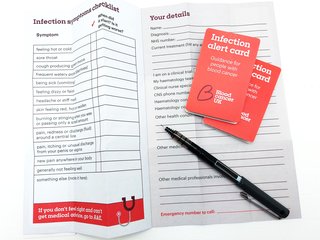
Order your free infection alert cards
With our pocket guide you can record infection symptoms and personal details to share with medical staff. Find out what to do and what to say if you go to A&E.
Late effects after T-ALL treatment
Late effects are side effects that start after your treatment has finished. You might not experience late effects, but it’s important to be aware of what can happen to your body after being treated for T-ALL, so that you know what to look out for and talk to your hospital team or GP about.
The risk of getting late effects after treatment can depend on factors such as:
- the type and intensity of the treatment you received
- your age at the time of treatment – those treated at a younger age have more time to develop certain late effects throughout their life
- other health conditions you may have
- lifestyle factors such as whether you smoke.
You will have follow-up appointments for some time after your treatment ends. During these follow-up appointments, your hospital team will check to make sure that the T-ALL has not returned, but they will also check for any late effects that you may be developing. If you had very intensive treatment, you’ll generally have more follow-up appointments, for a longer period of time.
Research into T-ALL
Researchers are looking into how to improve treatments for people with T-ALL.
CAR T-cell therapy
CAR T-cell therapy is a type of immunotherapy, which means it works by using someone’s own immune system to kill the cancer cells in their body. It’s not a standard treatment for T-ALL, but researchers are looking into how it might be able to be used to treat T-ALL in the future.
CAR T-cell therapy is already an important treatment for some types of blood cancer that are hard to treat and affect an immune cell called a B cell. Unfortunately however, up until now, CAR T-cell treatments haven’t been effective at treating blood cancers that affect T cells, like T-ALL. This is because instead of targeting the cancerous cells, it was found that the CAR-T cells destroy each other before they have a chance to destroy the leukaemia.
However, research is going on to try to change this.
Base edited CAR T-cell therapy (BE-CAR7 trial)
Base-edited CAR T-cell therapy is a treatment that’s being studied for blood cancers affecting the T-cells, like T-cell Acute lymphoblastic leukaemia. It uses a form of gene editing called base editing, to make changes to the DNA in the blood cells of healthy donors. This trains the cells to find and destroy cancer cells safely without harming other healthy blood cells, or the person being treated.
A trial called BE-CAR7 is researching the use of base-edited CAR T-cells for people with T-ALL that has come back after treatment (relapsed) or is not responding to treatment (refractory). This clinical trial is testing how safe this new treatment is for people with T-ALL, and how effective it is at getting them into remission, so that they can go on to have a donor stem cell transplant.
Find out more about the BE-CAR7 trial.

Ask the blood cancer community
On our online forum you’ll find a warm welcome from other people with blood cancer. And guidance from our specialist blood cancer nurses.
More About ThisAbout this information
Thank you to Professor Adele Fielding for supporting with the creation of this T-ALL information and checking the clinical accuracy.
This information was first published in June 2026. Next full review due June 2029. We may make factual updates between reviews.