
What is B-cell acute lymphoblastic leukaemia (B-ALL)?
B-ALL is a type of blood cancer that affects a type of white blood cell called a lymphoid blast.
If you have B-ALL, your lymphoid blasts begin to multiply in an uncontrolled way.
What you need to know
- B-ALL is a fast-growing type of blood cancer. This means that it is important that it is diagnosed and treated quickly.
- If you have B-ALL, your lymphoid blasts, a type of white blood cell, begin to multiply uncontrollably. These are known as leukaemia cells.
- As more of these leukaemia cells are made, they start to crowd out the normal, healthy blood cells in your bone marrow.
- When healthy blood cells are crowded out, it makes it hard for your body to do the things it normally does to keep you healthy, like fight infection.
What is B-ALL?
B-ALL is a type of blood cancer that affects a type of white blood cell called a lymphoid blast. It usually starts because of random changes in the lymphoid blasts, which happen just by chance.
Normally, lymphoid blasts are made in the bone marrow and then mature and develop into lymphocytes. A lymphocyte is a type of white blood cell which is really important for helping our bodies fight infection. Usually, our bone marrow makes the right number of lymphocytes to keep our immune system working normally.
If you have B-ALL, this process goes wrong. Instead of growing into lymphocytes, some of the lymphoid blasts begin to multiply in an uncontrolled way. These are known as leukaemia cells. As more and more of these leukaemia cells are made, they start to crowd out the normal, healthy blood cells in your bone marrow.
When healthy blood cells are crowded out, it makes it hard for your body to do the things it normally does to keep you healthy, like fight infection.
These leukaemia cells can then start to spill into your bloodstream and into other areas of your body.
B-ALL is a fast-growing type of blood cancer, which means that it's important that it is diagnosed and treated quickly.
''I remember when I was diagnosed, I just had this sensation that the world just stopped. Because I had just thought I was a little bit under the weather.''
Harry, diagnosed with B-ALL in 2023
Finding out you have blood cancer can be overwhelming. Find out what to expect and where to get support.

Philadelphia positive B-cell ALL (Ph+ B-ALL)
Around 1 in 4 adults (25%) with B-ALL have a type called Philadelphia positive B-ALL (Ph+ B-ALL). This means the leukaemia cells multiply in an uncontrolled way, because of a very specific genetic fault. This fault is only found in the leukaemia cells, not throughout your body. It is not the sort of genetic fault that can be passed down through families.
If you have Philadelphia positive B-ALL, your treatment plan will likely include a type of targeted treatment drug called tyrosine kinase inhibitors or TKIs. These drugs block the effects of the tyrosine kinase enzyme.
How does Ph+ B-ALL start?
Our bodies make millions of new cells all the time. Inside each cell are 23 pairs of chromosomes. Within these chromosomes is our DNA, which is organised into segments called genes. Our genes help determine who we are and what we look like, and they also give instructions to our cells – including when to divide, when to make more cells, and when cells should die.
When our cells divide to form new cells, the new cells should be exact copies – the chromosomes should stay exactly the same.
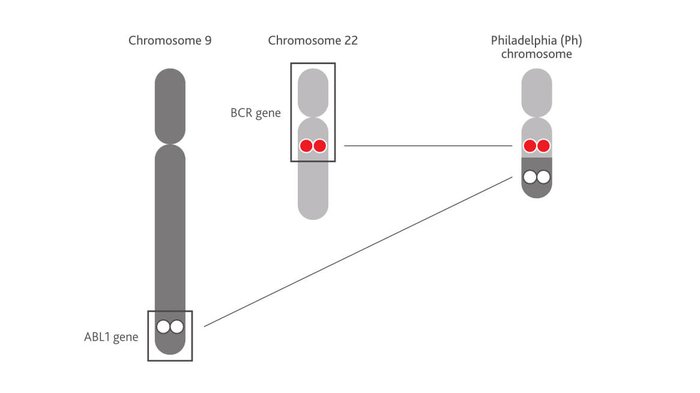
However, when someone has Philadelphia positive B-ALL, an abnormal swap happens between chromosomes 9 and 22. A small part of chromosome 9 (where the ABL1 gene sits) sticks to a small part of chromosome 22 (where the BCR gene sits). This creates a new, fusion gene called BCR-ABL1. This makes chromosome 22 shorter than normal.
This shorter chromosome is known as the Philadelphia chromosome.
The new BCR-ABL1 gene makes a protein known as tyrosine kinase. This protein is a type of enzyme (a substance which speeds up chemical processes) that tells the leukaemia cells to divide more often and to live longer than usual.
"My genetic test showed that I had Philadelphia positive B-ALL. Thanks to TKIs, outcomes are so much better than they were years ago."
Jesús, diagnosed with Philadelphia positive B-ALL in 2022
Other types of B-ALL
B-ALL can be divided into different types (also called sub-types) depending on the changes in the genes of the leukaemia cells. For now, most of these sub-types of B-ALL are treated in a similar way. However, researchers are working all the time to try to develop more targeted and personalised treatments for different types of B-ALL. Your doctors are likely to carry out specific genetic tests on your leukaemia cells, to find out more about your B-ALL.
What causes B-ALL?
Over 600 people a year are diagnosed with B-ALL. We don’t yet know exactly what causes it, but we do know there are some things that may make it more likely for someone to get it.
It’s important to know that none of your lifestyle choices have caused you to be diagnosed with B-ALL.
Age - B-ALL affects children more often than adults. It is most common in children under 4 years old. When B-ALL does occur in adults, it becomes more common again after the age of around 55.
Sex - B-ALL is slightly more common in males than females. We don’t yet know exactly why this is.
Genetics - Although people with B-ALL have a genetic change in the leukaemia cells themselves, in most cases, this is something that happens by chance. It isn’t something you inherited, and you cannot pass it on to your children.
However, having certain genetic conditions, like Down syndrome, can make a person slightly more likely to develop B-ALL.

Want to talk?
If you have questions or worries, ask a blood cancer nurse. Our specialist nurses can help you make sense of things. So you can talk to your hospital team with confidence.
More About ThisWhere next?
About this page
This information has been accredited with the PIF TICK, the UK's only quality mark for trusted health information.
Last full review June 2026. Next full review due June 2029. We may make factual updates between reviews.
Thank you to Consultant Haematologists Professor Adele Fielding and Dr Clare Rowntree for checking the clinical accuracy of our adult B-cell acute lymphoblastic leukaemia (B-ALL) information.
Thank you also to Karis, Ricky, Binu, Harry, Keri and Jesús for sharing their experiences and for helping with the creation of this information.