
What is myeloma?
Myeloma affects white blood cells called plasma cells. Plasma cells are made inside your bone marrow, the spongy material inside some of your bones.
Funding information
The following pharmaceutical companies and charitable organisations helped fund this information, but had no influence over it: Abbvie, AstraZeneca, Incyte, Jazz Pharmaceuticals, Kyowa Kirin, Roche, Sobi UK.
What you need to know:
- Myeloma (also called multiple myeloma) affects white blood cells called plasma cells.
- Affected plasma cells make abnormal antibodies called paraproteins, which don’t work properly.
- Some people have inactive myeloma that causes no symptoms and does not need treating straight away.
Myeloma, plasma cells and antibodies
Plasma cells make proteins called antibodies, also known as immunoglobulins. Antibodies travel around the body in your blood. They find and kill germs that cause infections, such as viruses, bacteria and fungi.
In myeloma, something goes wrong with your plasma cells. They start making antibodies that don’t work properly and can’t kill germs effectively. So you may get infections more often and that last longer.
These abnormal plasma cells – or myeloma cells – also grow more quickly than they should. They crowd your bone marrow so there isn’t enough room to make other blood cells. This leads to other symptoms of myeloma such as anaemia, which can make you feel tired.

Order your free guide to myeloma
Includes myeloma treatments, living well with myeloma and questions to ask your medical team.
Myeloma and paraproteins
The abnormal antibodies made by myeloma cells are called paraproteins. You might hear them called M-proteins, M-bands or M-spikes – these are all the same. If there is paraprotein in your blood, it may be a sign that you have myeloma.
Most people with myeloma will have regular blood tests to monitor the level of paraprotein in their blood. But some types of myeloma don’t make paraprotein and are monitored in other ways.
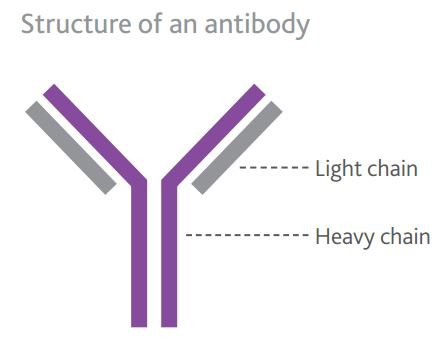
Antibodies are Y-shaped proteins that help us fight off infection. They are made up of structures called heavy chains and light chains.
Myeloma types
There are different types of myeloma which can be identified by diagnostic tests. The type of myeloma you have depends on:
- the type of paraprotein in your blood
- part of the paraprotein’s structure, called light chains.
There are five types of paraprotein: G, A, D, E and M. IgG (immunoglobulin G) is the most common type, IgA less common. The others are quite rare. Myeloma cells make only one type of paraprotein, and this varies from person to person.
There are two types of light chain: kappa (κ) and lambda (λ).
So when you are diagnosed with myeloma, you might be told you have IgG kappa myeloma, for example.
Genetic tests may show that you have a particular genetic subtype of myeloma. This information helps your hospital team to understand how the myeloma might progress. This is called your prognosis.
In future, we hope there will be targeted treatments for different genetic subtypes of myeloma.
"Don’t feel you have to learn all the terminology on day one – it’s natural to feel confused at first but you will get the hang of it."
Ian, living with myeloma since 2019
Read about how people like Ian are coping with a myeloma diagnosis.

What is smouldering myeloma?
Myeloma can be active or smouldering.
Active myeloma usually causes symptoms and needs treating quite quickly.
But people with smouldering myeloma don’t have any symptoms of myeloma. Because of this, you might hear it called asymptomatic myeloma. It is often diagnosed by chance when a person has a blood test for something else.
If you have smouldering myeloma, you may not need treatment for a while, if ever. Your hospital team will monitor you regularly until they recommend you start treatment. This approach is called active monitoring or watch and wait.
What is light chain myeloma?
One in five people with myeloma (20%) have light chain myeloma. In light chain myeloma, the myeloma cells don’t make whole paraproteins. They only make the light chain parts. Regular tests will monitor the level of light chains in the blood, and sometimes in the urine (wee).
If you have light chain myeloma, you may be told you have either kappa or lambda light chain myeloma. Kappa and lambda are the two types of light chain.
Find out more about tests for myeloma.
What is non-secretory myeloma?
Less than 3 in 100 people with myeloma (3%) have non-secretory myeloma. In this type of myeloma, the myeloma cells don’t make any paraprotein or light chains.
Sometimes, the myeloma cells make a very small amount of paraprotein or light chains. This is called oligo-secretory myeloma.
Non-secretory and oligo-secretory myeloma are hard to detect using blood tests. That’s why doctors and research scientists sometimes describe them as non-measurable myeloma. Tests may look normal, or almost normal, although there may be other changes seen in the blood.
If this is the case for you, then blood and urine tests may not be enough to check on your condition. Your doctor will monitor you using bone marrow samples and scans.

Information for the Black community
Get essential information about blood cancer including stories from Black people with blood cancer and where to find support.
Multiple myeloma
Myeloma is often called multiple myeloma. This is because it affects the bone marrow in more than one place and can affect other parts of the body.
Multiple myeloma and myeloma are different names for the same disease.
What causes myeloma?
We don’t fully understand what causes myeloma. But there are some things that can increase your risk. Read more about risk factors for myeloma.

Our research
Our £500 million investment in research since 1960 has helped transform treatments and taken us to the point where beating blood cancer is now in sight. Our researchers are working to finish the job.
More About ThisAbout this page
This information has been accredited with the PIF TICK, the UK's only quality mark for trusted health information.
Last full review May 2026. Next full review due May 2029. We may make factual updates between reviews.
Thank you to Consultant Haematologist Dr Emma Searle and Myeloma Nurse Practitioner Amie Martin for checking the clinical accuracy of our myeloma information. Thanks also to Cecelia, Craig, Joan, Kaleigh, Kerry, Louise, Mart, Sandra, Scott for supporting this project and sharing their experience of living with myeloma.